
Using C-Mount Focus Tunable Lenses
Introduction
Optotune Electrically Focus-Tunable Lenses provide flexible, fast-focusing solutions for a wide variety of machine vision applications, including quality control, sorting, or bar code reading. Unlike traditional optical setups, in which mechanical adjustments must be made for objects at different working distances, Optotune’s Electrically Focus-Tunable Lenses take only milliseconds to refocus and are free of mechanical translation. In addition to focusing applications, these lenses can reduce the number of light sources and the overall power consumption of adaptive illumination applications by providing highly flexible lighting parameters.
The C-mount version of the standard electrically focus-tunable lens (EL-10-30), the Optotune C-Mount Focus-Tunable Lens (EL-10-30-C), is compatible with standard industrial cameras. To allow for additional adjustments to the focal range, an offset lens can be integrated into the C-mount focus-tunable lens. When combined with a positive power offset lens, the tunable lens can achieve short focal lengths and be used directly with standard industrial cameras. With a negative power offset lens, the lens combination can be focused at infinity, allowing the EL-10-30-C to be placed in front of existing optical components as a close-up lens for fixed focal length lenses. Various configurations for different specifications are described in more detail in this application note.
Offset Lens
The EL-10-30-C’s protective glass can be replaced by a 12mm or 12.7mm diameter offset lens. This allows the focal range to be shifted to any desired value. For example, the VIS coated Optotune C-Mount Focus-Tunable Lens (#88-937) has a standard focal range of +200 to +80mm. By integrating an offset lens with a focal length of -150mm (#86-905), the focal range can be extended from about -600mm to infinity to +170mm (1/fres = 1/fEL-10-30 + 1/foffset). Note: The maximum allowable thickness of the offset lens is 4.7mm.
Doublet Configuration: EL-10-30-C for Camera Lenses

Table 1: Recommended Offset Lenses | ||||
|---|---|---|---|---|
Distance (D) | Focal Length of Offset Lens | Offset Lens Stock No. | Field of View* | Resulting Focal Length Range |
12.5mm | 20mm | #49-917 | 22.3° | 16 – 18mm |
17.5mm | 30mm | #45-484 | 17.4° | 22 – 26mm |
25mm | 42mm | #45-485 | 13.1° | 28 – 35mm |
*Full horizontal field of view on ½" format
Integrating a plano-convex offset lens creates a doublet system, and can be combined directly with standard industrial cameras. Focal lengths as short as 16mm can be achieved for sensor sizes up to ½". Figure 1 and Table 1 show the setup with recommended offset lenses depending on the distance (D) between the EL-10-30-C and the camera sensor. By changing the current applied to the tunable lens, refocusing for different working distances from 100mm to infinity can be achieved. Figure 2 shows a series of images taken at different working distances using an EL-10-30-C and a 30mm focal length plano-convex offset lens, an f/# of 5, and a C-mount camera with a ½" sensor size.
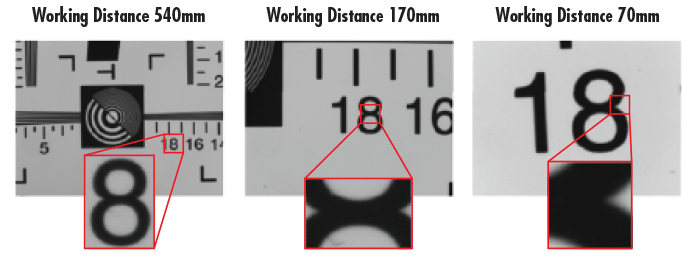
Figure 2: EL-10-30-C with Integrated 30mm FL PCX Lens
Close-Up Configuration: EL-10-30-C in Combination with Fixed Focal Length Lens
With an integrated plano-concave offset lens, the EL-10-30-C can also be used as a close-up lens for fixed focal length lenses. This combination creates a high optical quality, electronically controllable focusing unit. The fixed focal length lens alone would need to be refocused to accommodate different working distances. In the combined setup, all of the elements stay at a fixed position; only the curvature of the tunable lens is varied to achieve focusing for different working distances.
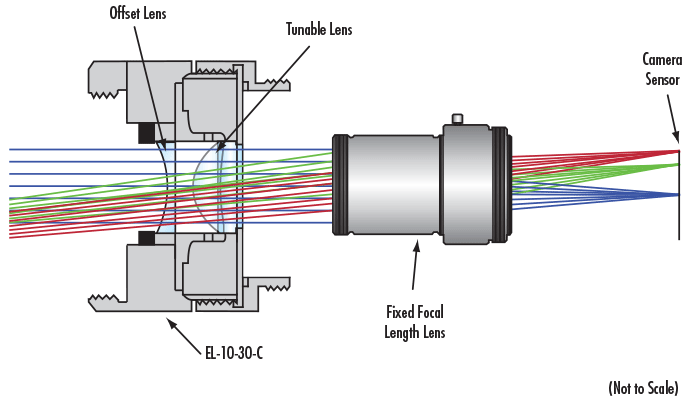
Figure 3: Diagram of Combined Setup
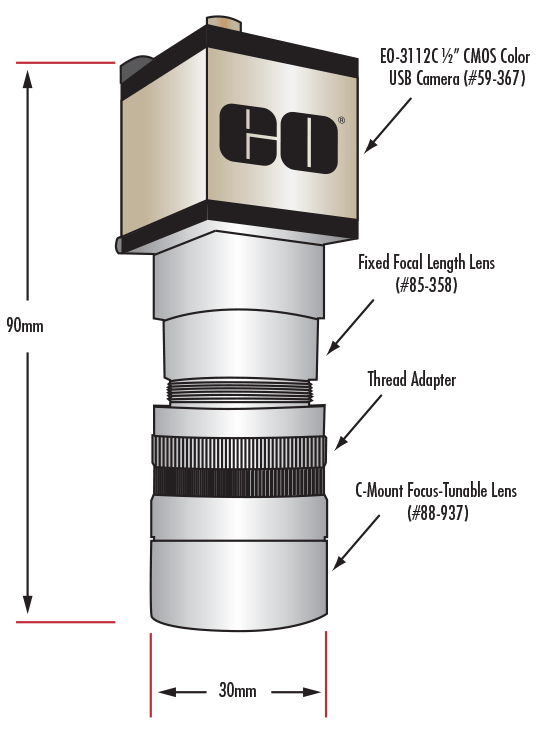
Figure 4: Combined Setup with Stock Numbers
An example of a combined setup can be seen in Figures 3 and 4. A -150mm focal length plano-concave offset lens (#86-905) is used with the plano side facing the tunable lens.
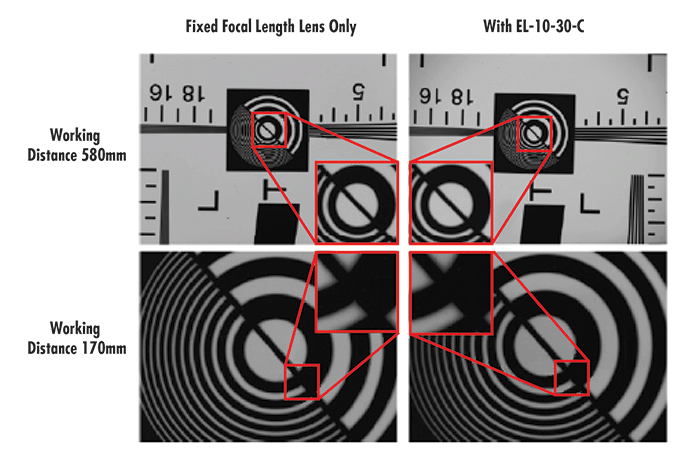
Figure 5: Optical Quality Comparison of Traditional and Combined Setups
The images in Figure 5 demonstrate that a combined setup can achieve the same level of quality as using only a fixed focal length lens. This configuration has a field of view of 14.5° (for ½" sensor sizes) and operates at f/4.
To prevent vignetting, it is recommended to use a fixed focal length lens with a short distance between the s position and the front of the lens. Vignetting is also a concern when using standard wide field lenses with short focal lengths and a field of view greater than 20° (for ½" sensor sizes). Recommended fixed focal length lenses with different field of views ranging from 6.2° to 14.5° (for ½" sensor sizes) are listed in Table 2.
Table 2: Recommended Fixed Focal Length Lenses for Multiple FOV, FL, and f/# | |||||
|---|---|---|---|---|---|
Field of View* | Stock Number | Focal Length | Working Distance | Aperture (f/#) | Maximum Sensor Size |
14.5° | #85-357 | 25mm | 20mm – ∞ | Fixed: 2.8 | 2/3" |
14.5° | #59-871 | 25mm | 20mm – ∞ | Variable: 2.8 – 17 | 2/3" |
13.3° | #58-207 | 25mm | 60mm – 1200mm | Fixed: 2.5 | 1/2" |
10.4° | #85-365 | 35mm | 50mm – ∞ | Fixed: 4 | 2/3" |
10.4° | #59-872 | 35mm | 50mm – ∞ | Variable: 4 – 22 | 2/3" |
8.2° | #54-689 | 35mm | 90mm – ∞ | Variable: 4 – closed | 1/2" |
6.2° | #59-873 | 50mm | 100mm – ∞ | Variable: 5 – 22 | 2/3" |
*Full horizontal field of view on standard ½" sensor
Wavefront Quality Dependent on Orientation and Focal Length Range
In principle, Optotune’s focus tunable lenses exhibit a spherical lens shape (the nominal parameters can be found in the ZEMAX package, which are located on the product page). Since the membranes used are elastic, the lens shape is influenced by gravity. With the lens oriented with the optical axis vertical, the RMS wavefront error of the EL-10-30-C series is in the order of 0.1λ (measured at 525nm). With the lens configured with a horizontal optical axis, a Y-coma term must be added; therefore, for the highest quality imaging, it is recommended to use the EL-10-30-C with the optical axis positioned vertically.
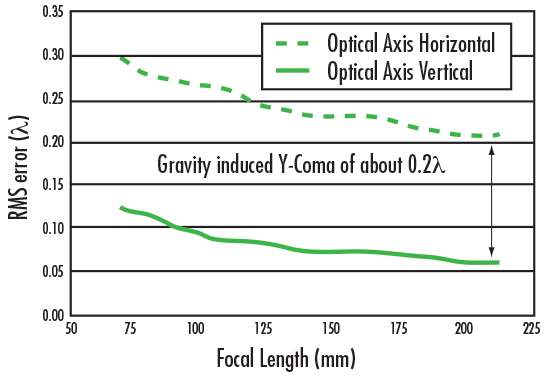
Figure 6: Wavefront Measurement of Electrically Focus-Tunable Lenses (at 532nm and 80% Clear Aperture)
Furthermore, as can be seen Figure 6, the lens exhibits a smaller wavefront error when it is less curved corresponding to longer focal lengths. It is recommended to set the position of the fixed focal length lens such that the tunable lens can be operated in the long focal range corresponding to low current values.
Response Time
The rise time on a current step is about 2.5ms. However, it takes about 15ms until the lens has fully settled.
Controlling Electrically Focus-Tunable Lenses
The EL-10-30-C’s focal length is controlled by changing the input current (0 – 300mA). For simple focusing applications, a calibration using a look-up table is sufficient to achieve good repeatability. If the heating of the lens is significant, then sensing the temperature is recommended to calculate more precise look-up values. Each lens has a temperature sensor and 256 bytes of memory built in.
版權(quán)所有 © 2026 江陰韻翔光電技術(shù)有限公司 備案號:蘇ICP備16003332號-1 技術(shù)支持:化工儀器網(wǎng) 管理登陸 GoogleSitemap


